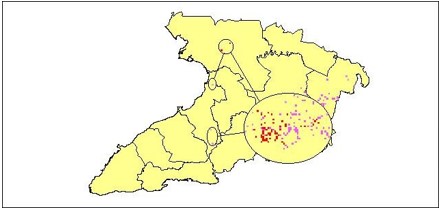
Distribución espacial de la Varroasis en Granma utilizando un Sistema de Información Geográfica (SIG)
Article Sidebar
Main Article Content
Abstract
-
Article Details

This work is licensed under a Creative Commons Attribution-NonCommercial 4.0 International License.
Those authors who have publications with this journal accept the following terms of the License Attribution-NonCommercial 4.0 International (CC BY-NC 4.0):
You are free to:
- Share — copy and redistribute the material in any medium or format
- Adapt — remix, transform, and build upon the material
The licensor cannot revoke these freedoms as long as you follow the license terms.
Under the following terms:
- Attribution — You must give appropriate credit, provide a link to the license, and indicate if changes were made. You may do so in any reasonable manner, but not in any way that suggests the licensor endorses you or your use.
- NonCommercial — You may not use the material for commercial purposes.
- No additional restrictions — You may not apply legal terms or technological measures that legally restrict others from doing anything the license permits.
The journal is not responsible for the opinions and concepts expressed in the works, they are the sole responsibility of the authors. The Editor, with the assistance of the Editorial Committee, reserves the right to suggest or request advisable or necessary modifications. They are accepted to publish original scientific papers, research results of interest that have not been published or sent to another journal for the same purpose.
The mention of trademarks of equipment, instruments or specific materials is for identification purposes, and there is no promotional commitment in relation to them, neither by the authors nor by the publisher.
How to Cite
References
Aguirre, L, J, L.; Demedios, L, J.; Espaine, A, L, C. Pesquisa de Varroa jacobsoni oudemans y
Acarapis woodi en apiarios de Baja California Sur, México. Revista de producción animal.
Vol.10:81-82. 1999. Cuba
enavides, Ketty, G, A. Evaluación de la mezcla de propóleo-sábila como cicatrizante en caninos. Revista veterinaria y zootecnia de Caldas. Vol.8(2):55.1995. . FONAIAD Divulga Vol. XII(48):6:9. 1995. Venezuela.
Demedios, J.; Sanabria, J.; Espain, L. C.; Verde, Mayda.; Concepción, Dayaivet.; Vasallo, S. Optimización del uso de tiras de Bayvarol para el tratamiento de la varroasis de las abejas. V congreso nacional de médicos veterinarios.189p. 2000. Cuba.
Erickson, H, E.; Hines, L, H.; Atmowidjojo, A, H. Producción de abejas tolerantes a Varroa a partir de la población local adaptada: una receta. Apiciencia para el apicultor. 3(1):2-4. 2003. Cuba.
Flores, J, M.; Ruiz, J. A.; Ruz, J, M.; Puerta, F.;Bustos, M. Apicultura situación actual de la parasitosis por Varroa. [en línea] [Consulta:12 enero 2003]. www.eumedia.es/articulos/mg/120apicultura.html.2000
Gonzáles, Magally.; Piccirillo, G. Distribución de los apiarios y diagnóstico sanitario de las abejas africanizadas, Apis mellifica sautela (l) (Hymenóptera: Apidae), del estado de Zulia. Revista de la facultad de agronomía. Vol. 12(2): 269-283.1995. Venezuela.
Jiménez P., M. T.; Bustillo P.,A. E.; Luque Z.. , J. E. Impacto del uso de endosulfan y clorpírifos, sobre la Apis mellifica en ecosistemas cafetaleros de Colombia. Cenicafé. Vol.47(2):91-99. 1996. Colombia
Kindersley, D, Abeja obreras en la colmena. En ed Sánchez, S, R. Enciclopedia Encarta 2000. Estados Unidos.
Divulga. Vol. XI(46):13-14. 1994. Venezuela.
Manrique, A. J. La varroasis diagnóstico y control. FONAIAD Divulga Vol. XII(46):15-17. 1994.
Venezuela.
Martínez-Piedra, R. EpiGIS. Programa de Aplicación para usuario final EpiGIS. Instituto de Medicina Tropical “Pedro Kouri”. 1996. Ciudad de la Habana. Cuba.
MINAGRI. Varroasis Medidas de lucha y control, el uso de panal trampa. Ciudad de la Habana. 2000. Nimo, Mercedes. Comercio de la miel.[en línea].Boletín Apícola # 15.Argentina.[Consulta 27 marzo
. http://www.sagpya.mecon.gov.ar/alimentos/apicolas/inicio.htm. 2002
Pastor, Nancy. Curando a las abejas Apicultura: Efectivo tratamiento contra la varroasis [en línea]. Edición Electrónica del Cable #409. Segunda parte.Argentina.2001.[Consulta 12 enero 2003] http://alen.ait.uvigo.es/cita2001/jitt01.
Percedo, María, I.; Sánchez, Aida.; Blanco A, L.; Menendez, H, L.; Boffil, V, P. Desastre biológico. Papel de la Medicina Veterinaria en casos de desastre. Editorial Félix Valera. 109-163p.1995. Cuba.
Pinto, A. El control de la Varroa a base de Timol. [en línea]. Chile 2003.[Consulta:27 marzo 2003] http://.ciderebiobio.cl/Timol.htm.
Prandin, L.; Dainese, N.; Girardi, B.; Damolin, O.; Piro, R.; Mutinelli, F. Varroasis control: stability of homemade oxalic acid water sugar solution. 37 International Apicultural Congress. p:48- 147.2001. South Africa.
Sotero, Margarita.; Perez, H, S.; García, Marilín. Protección medio ambiental utilizando istemas territoriales de información geográfica. Tesis de Maestría. 2002. Cuba.
Vandame, R.; Colin, M.; Otero, C, G. Abejas Europeas y abejas Africanizadas en México: la tolerancia a Varroa jacobsoni. Primera Parte: Biología de Varroa.[en línea]. [Consulta:27 marzo 2003 remy.vandame@univ-lyonl.fr. 1996, México.
Verde, Mayda. Lucha integrada para el control de la varroasis. Tabloide. Bayer. División Sanidad Animal.2001. Cuba.
Villanova, C. La miel salva a las abejas.[en línea].España.2002.[Consulta:30 marzo 2003] www.mercoopsur.com.ar/apicultura/notas/lamielsalva.htm. 2002, España.
Villanueva, G, R.; Colli-can, W. La apicultura en la península de Yucatán mexicana y sus perspectivas. Folia entomológica mexicana. #97:55-70.1996. México.