La calidad de las reinas de Apis mellifera L. obtenidas con diferentes sustratos
Article Sidebar
Main Article Content
Abstract
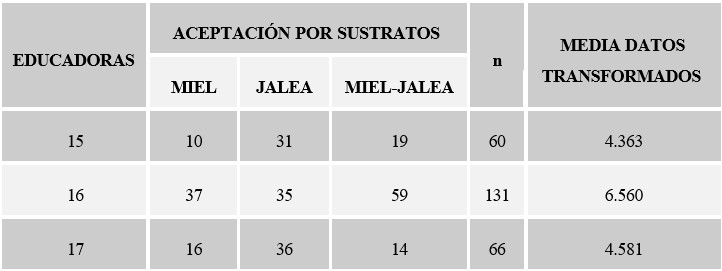
En el criadero de reinas de abejas melíferas de la provincia de Camagüey se evaluó la efectividad de la miel, jalea real y miel – jalea como sustratos para el trasvase de larvas para la crianza de las reinas. El material biológico utilizado fueron larvas provenientes de reinas de la cuarta generación de un programa nacional de selección aplicado en el criadero. Las colonias educadoras fueron seleccionadas por su buena población y salud y recibieron cada una un bastidor o cuadro con un tipo de sustrato, alternándose a medida que se realizaban los traslados. Se pesaron las reinas al nacer (PN) y después de fecundadas (PLF), comparándose las medias para cada sustrato y se establecieron regresiones entre la aceptación y el PN, aceptación y PLF y PN - PLF. No se encontraron diferencias significativas entre sustratos en cuanto a aceptación de las larvas por las colonias educadoras, PN y PLF. De las regresiones solo resultó significativa la establecida entre el PN y PLF en el sustrato jalea. Se concluye que los sustratos utilizados resultaron apropiados para el traslado de las larvas de futuras reinas.
Article Details

This work is licensed under a Creative Commons Attribution-NonCommercial 4.0 International License.
Those authors who have publications with this journal accept the following terms of the License Attribution-NonCommercial 4.0 International (CC BY-NC 4.0):
You are free to:
- Share — copy and redistribute the material in any medium or format
- Adapt — remix, transform, and build upon the material
The licensor cannot revoke these freedoms as long as you follow the license terms.
Under the following terms:
- Attribution — You must give appropriate credit, provide a link to the license, and indicate if changes were made. You may do so in any reasonable manner, but not in any way that suggests the licensor endorses you or your use.
- NonCommercial — You may not use the material for commercial purposes.
- No additional restrictions — You may not apply legal terms or technological measures that legally restrict others from doing anything the license permits.
The journal is not responsible for the opinions and concepts expressed in the works, they are the sole responsibility of the authors. The Editor, with the assistance of the Editorial Committee, reserves the right to suggest or request advisable or necessary modifications. They are accepted to publish original scientific papers, research results of interest that have not been published or sent to another journal for the same purpose.
The mention of trademarks of equipment, instruments or specific materials is for identification purposes, and there is no promotional commitment in relation to them, neither by the authors nor by the publisher.
How to Cite
References
Arrieta, E. 1989. Valoración de algunos indicadores que inciden en la calidad de las reinas. Trabajo de diploma. Universidad de Camagüey.
Flores, J. M.; J. A. Ruíz; F. Puerta; F. Campono; F. Padilla y M. Busto. 1998. Cría controlada de abejas reinas de Apis mellifera ibérica. Archivos de Zootécnia. 47: 347-350.
Raimatov, K. 1982. La producción de abejas reinas en un centro de desarrollo apícola. Información Express. Vol. 6 No 2 (17): 13-14.
Ruttner, F. 1989. Selección y cria de abejas melíferas. Vida Apícola. 34: 45-53.
Taranov, G. F. 1973. Condiciones para mejorar la calidad de las reinas en las granjas apícolas especializadas. XXIV Congreso Internacional Apimondia. Pág. 313-315.