Evaluation of proline content in cuban monofloral honeys
Article Sidebar
Main Article Content
Abstract
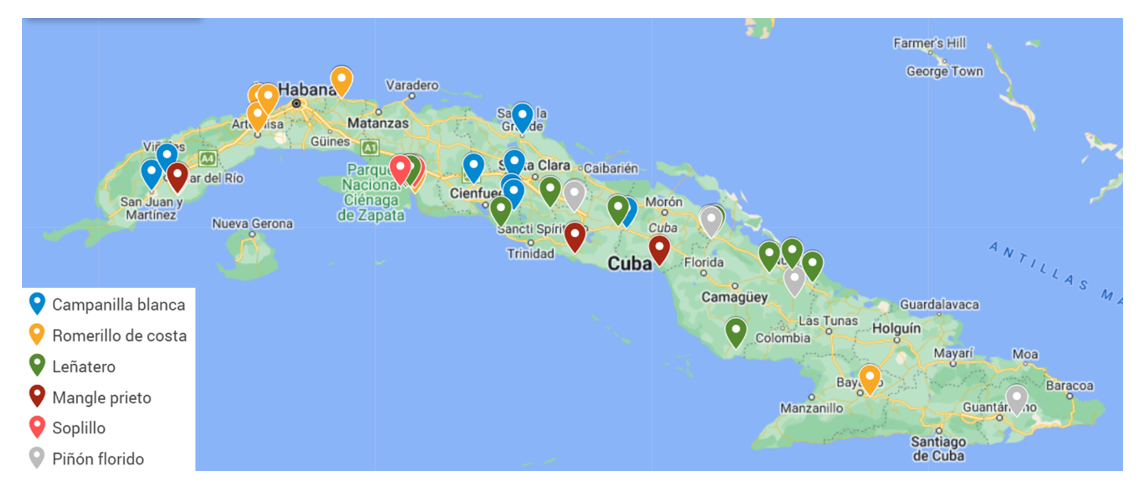
Proline is the most abundant amino acid in honey and its determination constitutes an additional quality parameter contemplated in international regulations. However, the content of this amino acid in Cuban honeys has been little studied. Precisely, in this work authors propose to study the proline content in Cuban monofloral honeys. Honeys from sunflower goldeneye, black mangrove, singing bean, linen vine, christmas vine and quickstick, obtained directly from local beekeepers, were used. The proline concentration was estimated using the harmonized method recommended by the International Honey Commission. The highest proline content was found in the honeys of singing bean honey (359 mg/kg ± 45 mg/kg) and quickstick (358 mg/kg ±65 mg/kg), while christmas vine honey presented the lowest values (109 mg/kg ± 30 mg/kg). All the christmas vine samples showed proline concentration below the limit of 180 mg/kg established. From these studies, it should be taken into account in the quality control analysis that, for some Cuban honeys, as christmas vine, the proline content is low and does not represent that honey is adulterated or immature.
Article Details

This work is licensed under a Creative Commons Attribution-NonCommercial 4.0 International License.
Those authors who have publications with this journal accept the following terms of the License Attribution-NonCommercial 4.0 International (CC BY-NC 4.0):
You are free to:
- Share — copy and redistribute the material in any medium or format
- Adapt — remix, transform, and build upon the material
The licensor cannot revoke these freedoms as long as you follow the license terms.
Under the following terms:
- Attribution — You must give appropriate credit, provide a link to the license, and indicate if changes were made. You may do so in any reasonable manner, but not in any way that suggests the licensor endorses you or your use.
- NonCommercial — You may not use the material for commercial purposes.
- No additional restrictions — You may not apply legal terms or technological measures that legally restrict others from doing anything the license permits.
The journal is not responsible for the opinions and concepts expressed in the works, they are the sole responsibility of the authors. The Editor, with the assistance of the Editorial Committee, reserves the right to suggest or request advisable or necessary modifications. They are accepted to publish original scientific papers, research results of interest that have not been published or sent to another journal for the same purpose.
The mention of trademarks of equipment, instruments or specific materials is for identification purposes, and there is no promotional commitment in relation to them, neither by the authors nor by the publisher.
How to Cite
References
Alvarez-Suarez, J. M., Tulipani, S., Díaz, D., Estevez, Y., Romandini, S., Giampieri, F., Damiani, E., Astolfi, P., Bompadre, S., & Battino, M. (2010). Antioxidant and antimicrobial capacity of several monofloral Cuban honeys and their correlation with color, polyphenol content and other chemical compounds. Food and Chemical Toxicology, 48(8-9), 2490-2499. https://doi.org/10.1016/j.fct.2010.06.021
Bogdanov, S. (2009). Harmonised Methods of the International Honey Commission. https://www.ihc-platform.net/wp-content/uploads/2024/08/ihcmethods2009.pdf
Bogdanov, S. (2012). Honey as nutrient and functional food. Proteins, 1100, 1400-2700.
Bogdanov, S., Jurendic, T., Sieber, R., & Gallmann, P. (2008). Honey for Nutrition and Health: A Review. Journal of the American College of Nutrition, 27(6), 677-689. https://doi.org/10.1080/07315724.2008.10719745
Czipa, N., Borbély, M., & Győri, Z. (2012). Proline content of different honey types. Acta Alimentaria, 41(1), 26-32. https://doi.org/10.1556/AAlim.2011.0002
Demir, E., & Bayram, N. E. (2018). Specifying Some Quality Characteristics of Monofloral and Multifloral Honey Samples. Hacettepe Journal of Biology and Chemistry, 3(46), 417-423. https://doi.org/10.15671/HJBC.2018.249
Gün, R., & Karaoğlu, M. M. (2022). Detection of Honey Adulteration by Investigation of the Physico-chemical Properties of Honey Adulterated with the Addition of Glucose-Fructose and Maltose Corn Syrups. https://doi.org/10.21203/rs.3.rs-2247350/v1
Jalili, M., Alaii Rouzbahani, Z., & Rahmani, A. (2023). To investigate the effect of long-term storage on the physicochemical properties of honey. Advances in the Standards & Applied Sciences, 1(3). https://doi.org/10.22034/asas.2023.390055.1021
Machado, A. M., Tomás, A., Russo-Almeida, P., Duarte, A., Antunes, M., Vilas-Boas, M., Graça Miguel, M., & Cristina Figueiredo, A. (2022). Quality assessment of Portuguese monofloral honeys. Physicochemical parameters as tools in botanical source differentiation. Food Research International, 157, 111362. https://doi.org/10.1016/j.foodres.2022.111362
Machado De-Melo, A. A., Almeida-Muradian, L. B. de, Sancho, M. T., & Pascual-Maté, A. (2018). Composition and properties of Apis mellifera honey: A review. Journal of Apicultural Research, 57(1), 5-37. https://doi.org/10.1080/00218839.2017.1338444
Nisbet, C., Kazak, F., & Ardalı, Y. (2018). Determination of Quality Criteria that Allow Differentiation Between Honey Adulterated with Sugar and Pure Honey. Biological Trace Element Research, 186(1), 288-293. https://doi.org/10.1007/s12011-018-1305-2
Oficina nacional de normalización. (2017). Apicultura. Miel monofloral de bejuco indio o leñatero (Gouania polygama (Jacq.) Urb.). Especificaciones. NC 1220.
Oficina nacional de normalización. (2017). Apicultura. Miel monofloral de campanilla blanca (Turbina corymbosa L.). Especificaciones. NC 1221.
Oficina nacional de normalización. (2018). Apicultura. Miel monofloral de romerillo de costa (Viguiera helianthoides H.B.K). Especificaciones. NC 1241.
Oficina nacional de normalización. (2018). Apicultura. Miel monofloral de soplillo (Lysiloma latisiliquum (L.) Benth.). Especificaciones. NC 1240.
Oficina Nacional de Normalización. (2019). Apicultura. Miel monofloral de mangle prieto (Avicennia germinans (L.) L.). Especificaciones. NC 1283.
Pascual-Maté, A., Osés, S. M., Fernández-Muiño, M. A., & Sancho, M. T. (2018). Methods of analysis of honey. https://www.tandfonline.com/doi/full/10.1080/00218839.2017.1411178
Rebane, R., & Herodes, K. (2008). Evaluation of the Botanical Origin of Estonian Uni- and Polyfloral Honeys by Amino Acid Content. Journal of Agricultural and Food Chemistry, 56(22), Article 22. https://doi.org/10.1021/jf8018968
Szczęsna, T., Rybak-Chmielewska, H., Waś, E., Kachaniuk, K., & Teper, D. (2011). Characteristics of polish unifloral honeys. I. Rape honey. Journal of Apicultural Science, 55(1), 111-119.
Thrasyvoulou, A., Tananaki, C., Goras, G., Karazafiris, E., Dimou, M., Liolios, V., Kanelis, D., & Gounari, S. (2018). Legislation of honey criteria and standards. Journal of Apicultural Research, 57(1), 88-96. https://doi.org/10.1080/00218839.2017.1411181
Tosun, M., & Keles, F. (2021). Investigation methods for detecting honey samples adulterated with sucrose syrup. Journal of Food Composition and Analysis, 101, 103941. https://doi.org/10.1016/j.jfca.2021.103941
Von Der Ohe, W., Persano Oddo, L., Piana, M. L., Morlot, M., & Martin, P. (2004). Harmonized methods of melissopalynology. Apidologie, 35(Suppl. 1), S18-S25. https://doi.org/10.1051/apido:2004050
Yang, J., Liu, Y., Cui, Z., Wang, T., Liu, T., & Liu, G. (2024). Analysis of Free Amino Acid Composition and Honey Plant Species in Seven Honey Species in China. Foods, 13(7), 1065. https://doi.org/10.3390/foods13071065
Yiğit, Y., Yalçın, S., & Onbaşılar, E. E. (2024). Effects of Different Packaging Types and Storage Periods on Physicochemical and Antioxidant Properties of Honeys. Foods, 13(22), 3594. https://doi.org/10.3390/foods13223594
Yoldas, T., Karagül, B., & Düvenci̇, E. S. (2023). Investigation of Some Quality Criteria in Chestnut Honey of Düzce Province. Düzce Üniversitesi Bilim ve Teknoloji Dergisi, 11(5), 2255-2264. https://doi.org/10.29130/dubited.1383148